Description
Masterclass Dry-Needling – Individual
Regenerative Dry Needling™ — Part 1: Dry Needling for the Rehabilitation Professional
Fri.26th to sun.28th June, 2026 – Paris, France
Torrentia Biomedical Training · 8 hrs didactic + 21 hrs interactive lab
Total hours
29 HOURS
Format
ONLINE PRE-COURSE + 3-DAY IN-PERSON
Prerequisites
NONE
Assessment
WRITTEN + ORAL-PRACTICAL EXAM
This course explains the biochemical, biomechanical, endocrinological, and neurovascular mechanisms behind the anti-inflammatory and analgesic effects of both manual and electric dry needling — grounded in western medicine and human anatomy.
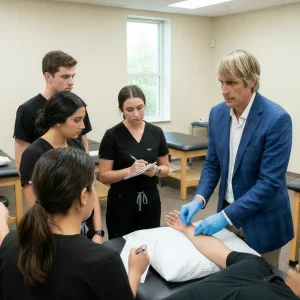
Students receive didactic and hands-on training in dry needling safety, technique, and dose for muscle, ligaments, tendons, fascia, scar tissue, and peri-neural tissue — then apply this knowledge to complex neuromusculoskeletal conditions of the appendicular skeleton.
Emphasis is placed on pain-related degenerative conditions (osteoarthritis, impingement, neural entrapment, tendinopathy, myopathy) and on integrating dry needling with regenerative medicine procedures including PRP, bone marrow aspirate concentrate, and adipose-derived stem cells.
Lead instructors
Online pre-course (8 hrs — self-paced)
1 hr
Dry needling safety
1 hr
Dry needling technique
2 hrs
Dry needling dose — manual and electric variables
2 hrs
Physiologic mechanisms associated with dry needling
2 hrs
Dry needling for osteoarthritis, tendinopathy, and fasciopathy
Day 1 – Friday (7 Hours)
Theme: Foundational Techniques → Tissue-Specific Applications → Shoulder Integration
8:00AM – 9:30AM
(1.5 hrs)
Introduction and Review of Dry Needling Technique and Dose – Lecture
9:30AM – 11:00AM
(1.5 hrs)
Myofascial Trigger Point Dry Needling – Lab
11:00AM – 12:00PM
(1 hr)
Dry Needling for Teno-Osseous Insertions (Basic and Advanced) – Lab
12:00PM – 1:00PM
Lunch break
1:00PM – 2:30PM
(1.5 hrs)
Dry Needling for Connective Tissue + Introduction to Electrical Stimulation – Lab
2:30PM – 3:00PM
(0.5 hr)
Dry Needling for Scar Tissue (Fibrosis, Keloid) – Lab
3:00PM – 5:00PM
(2 hrs)
Applications: Shoulder Conditions
(OA, Impingement, Rotator Cuff Tendinopathy, Adhesive Capsulitis) – Lab
Day 2 – Saturday (7 Hours)
Theme: Upper Extremity Completion → Transition to Lower Extremity
8:00AM – 10:00AM
(2 hrs)
Applications: Elbow Conditions
(Medial/Lateral Epicondylitis, UCL, Supinator, Cubital Tunnel) – Lab
10:00AM – 11:30AM
(1.5 hrs)
Applications: Wrist and Hand
(Carpal Tunnel, Guyon Canal, TFCC, Trigger Finger, CMC Joint) – Lab
11:30AM – 12:30PM
Lunch break
12:30PM – 2:00PM
(1.5 hrs)
Applications: Knee
(OA, Patellofemoral Pain, Patellar Tendinopathy) – Lab
2:00PM – 3:30PM
(1.5 hrs)
Applications: Posterior Knee
(Baker’s Cyst, Hamstring Tendinopathy, Gastrocnemius/Soleus, Shin Splints) – Lab
3:30PM – 4:30PM
(1 hr)
Applications: Ankle
(OA, High Ankle Sprains, Achilles Tendinopathy) – Lab
Day 3 – Sunday (7 Hours)
Theme: Distal Lower Extremity → Clinical Integration → Synthesis
8:00AM – 10:00AM
(2 hrs)
Applications: Foot
(Plantar Fasciitis, Fat Pad Syndrome, Morton’s Neuroma, Fibularis Tendinopathy, 1st MTP) – Lab
10:00AM – 11:30AM
(1.5 hrs)
Integrated Lower Extremity Treatment Systems
(Knee → Ankle → Foot sequencing; regional interdependence) – Lab
11:30AM – 12:30PM
Lunch break
12:30PM – 2:00PM
(1.5 hrs)
Clinical Case-Based Application
• Multi-region treatment planning
• Dose manipulation (manual vs electric)
• Tissue prioritization
2:00PM – 3:30PM
(1.5 hrs)
Advanced Clinical Integration + Mock Practical
• Full extremity treatment flow
• Instructor-guided corrections
• Preparation for oral-practical check-off
Evaluated via oral-practical check-off and written exam. Participants completing this course will be able to:
- Describe 2 relative and absolute contraindications of dry needling
- Identify 3 serious adverse events and demonstrate clean needling technique and disposal
- Demonstrate safe dry needling technique for active/latent trigger points and tender points
- Demonstrate 3 techniques to appropriately dose dry needling treatment
- Explain 3 physiologic mechanisms related to pain reduction via dry needling
- Explain 3 physiologic mechanisms related to tissue repair and remodeling
- Explain 2 physiologic justifications for treating osteoarthritis with dry needling
- Cite findings from 2 recent publications on dry needling for tendinopathy
- Set up and treat using 2 different electric stimulation protocols
- Compare high vs. low frequency electric stimulation for dry needling
- Demonstrate electric dry needling for OA of the shoulder, knee, and ankle
- Demonstrate dry needling for shoulder impingement and rotator cuff tendinopathy
- Compare and demonstrate needling technique for teno-osseous insertions
- Describe the theoretical construct of the localized twitch response
- Demonstrate dry needling for medial and lateral epicondylitis
- Demonstrate electric dry needling for carpal tunnel and Guyon’s tunnel syndrome
- Demonstrate electric dry needling for Achilles and patella tendinitis
- Demonstrate evidence-based dry needling for plantar fasciitis
- Compare and contrast dry needling strategies pre and post regenerative medicine
- Demonstrate dry needling following stem cell and/or PRP procedures
- Demonstrate evidence-based dry needling for chronic high and low ankle sprains
Date
fri.26th to sun.28th June, 2026
Evaluation
Oral/practical exam (100 pts) + written exam (100 pts) — pass ≥ 140/200
Passing score
70% (140 out of 200 points)
Recording policy
No recording devices permitted without instructor permission
Accessibility
Contact instructors prior to course for disability accommodations
In association with :